Ninghan Zhong

Robotics PhD student · Georgia Tech

EmailCVGoogle ScholarGitHubLinkedIn
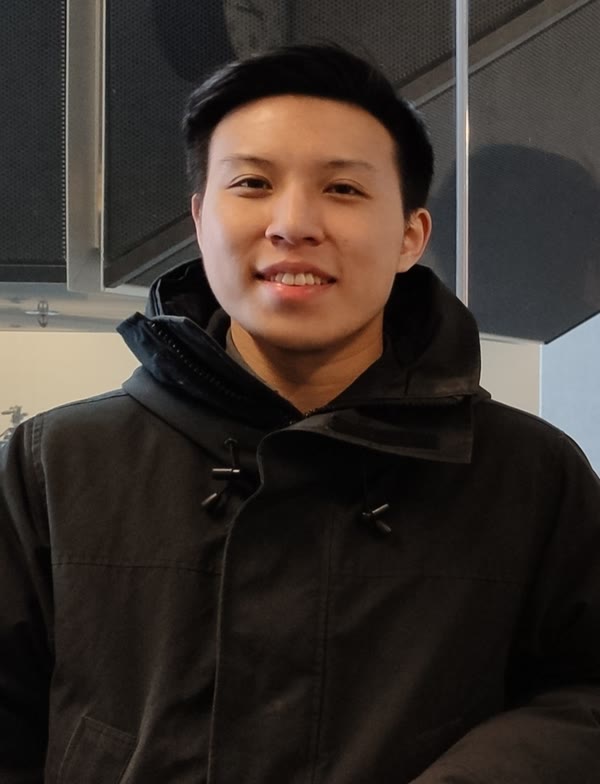
Portrait of Ninghan Zhong

I’m a Robotics PhD student at Georgia Tech, advised by Prof. Sriram Vishwanath and working in close collaboration with Prof. Glen Chou. My research sits where robot learning meets planning. My ongoing work focuses on latent world models that plan from vision and touch.

I received the MASc degree in Electrical and Computer Engineering from the University of Waterloo, advised by Prof. Stephen L. Smith. I graduated with a B.S. in Computer Science from the University of Illinois at Urbana-Champaign, where I collaborated with Prof. Kris Hauser and Prof. Katherine Driggs-Campbell.

News

Research

Steering VLAs with Visual Plans

  1. arXiv 2026

    GT-VLA: Target-Conditioned Trace Guidance for Generalizable Robotic Manipulation

    Ninghan Zhong*, Jing-Chen Peng*, Sriram Vishwanath (*equal contribution)

    Turns a generalist VLM’s guidance into 2D visual traces that steer a VLA policy, so it generalizes to unseen and long-horizon tasks.

    VLAManipulationVisual traces
    ProjectPaperarXivCode (soon)

Learning and Planning Through Physical Contact

  1. CRV 2026

    Bench-Push: Benchmarking Pushing-based Navigation and Manipulation Tasks for Mobile Robots

    Ninghan Zhong*, Steven Caro*, Megnath Ramesh, Rishi Bhatnagar, Avraiem Iskandar, Stephen L. Smith (*equal contribution)

    The first unified benchmark for pushing-based mobile robots, with four task families, new metrics for efficiency and interaction effort, and baseline results.

    BenchmarkPushingMobile robots
  2. ICRA 2025

    Autonomous Navigation in Ice-Covered Waters with Learned Predictions on Ship-Ice Interactions

    Ninghan Zhong, Alessandro Potenza, Stephen L. Smith

    Learns how broken ice moves when a ship pushes through it, then plans with those predictions to cut collisions in simulation and on a physical testbed.

    Learned dynamicsMotion planningIce navigation
  3. T-RO 2025

    AUTO-IceNav: A Local Navigation Strategy for Autonomous Surface Ships in Broken Ice Fields

    Rodrigue de Schaetzen, Alexander Botros, Ninghan Zhong, Kevin Murrant, Robert Gash, Stephen L. Smith

    Plans ship paths through broken ice by minimizing the kinetic energy lost to ship-ice collisions, refining lattice-planner paths with optimization.

    Motion planningOptimizationIce navigation

Earlier Work: Human-Robot Interaction

  1. RA-L 2024

    Attentiveness Map Estimation for Haptic Teleoperation of Mobile Robot Obstacle Avoidance and Approach

    Ninghan Zhong, Kris Hauser

    Estimates which obstacles a teleoperator has noticed and softens haptic feedback for intentional approaches, improving task performance, safety and user experience.

    HapticsTeleoperationHuman attention
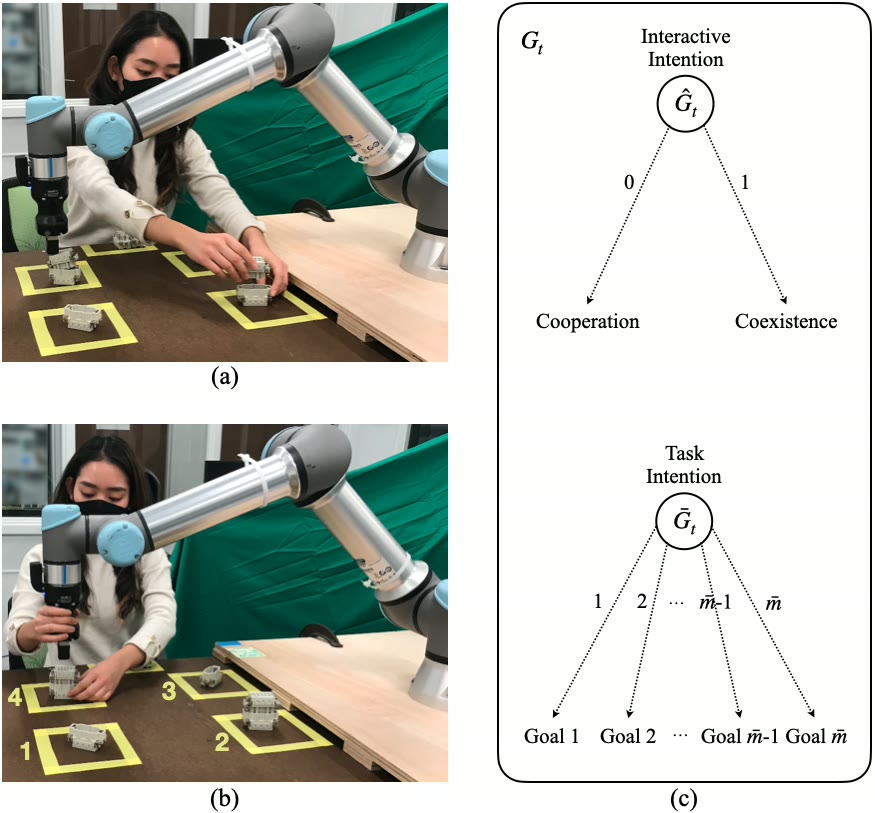
  2. A UR5e robot working with a person on an assembly task, next to the two-level intention diagram
    ICRA 2023

    Hierarchical Intention Tracking for Robust Human-Robot Collaboration in Industrial Assembly Tasks

    Zhe Huang*, Ye-Ji Mun*, Xiang Li†, Yiqing Xie†, Ninghan Zhong†, Weihang Liang, Junyi Geng, Tan Chen, Katherine Driggs-Campbell (* and † equal contribution)

    Tracks human intention at two levels so a collaborative robot can avoid interrupting a worker and help correct assembly failures.

    Human-robot collaborationIntention estimation

Experience

Georgia Tech
PhD in Robotics
2025–present

University of Waterloo
MASc in ECE, Autonomous Systems Lab
2023–2025

UIUC
Research Assistant, Intelligent Motion Lab
2022–2023
UIUC
B.S. in Computer Science, Highest Honors
2018–2022

Golden Ridge Robotics
Computer Vision & Algorithms Intern
May–Jul 2021

Awards and Honors

  • International Master’s Award of Excellence ($12,500 CAD), University of Waterloo
  • The Highest Honors at graduation, UIUC

Service and Teaching

Journal reviewer
IEEE Transactions on Robotics (T-RO), Reliability Engineering & System Safety
Conference reviewer
IROS 2025, MRS 2025
Teaching assistant
ECE 208 Discrete Math II, University of Waterloo (Spring 2024)
ECE 484 Principles of Safe Autonomy, UIUC (Spring 2022)