Publications
All publications, newest first.
2026
- arXiv 2026
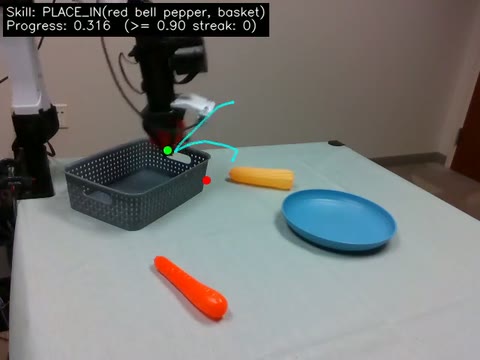 GT-VLA: Target-Conditioned Trace Guidance for Generalizable Robotic ManipulationNinghan Zhong*, Jing-Chen Peng*, and Sriram VishwanatharXiv preprint arXiv:2609.31904, Sep 2026
Vision-Language-Action (VLA) models have shown strong performance on robotic manipulation, but they often struggle to generalize to unseen tasks, configurations, and long-horizon settings. A key challenge is that VLAs overfit to training scenes and fail to follow novel language instructions. Off-the-shelf vision-language models (VLMs) often provide stronger generalization, but cannot directly control robot actions. To combine the common sense of VLMs with VLA control, we propose Guided Trace VLA (GT-VLA), a steerable framework that accepts guidance from an external generalist VLM through trace-conditioned action generation. GT-VLA uses a generalist model to identify semantic guidance for the current skill, converts this guidance into a 2D visual trace, and conditions its action policy on the resulting trace-rendered observation. This design separates semantic target acquisition, trace generation, and low-level action execution, allowing high-level guidance to propagate to robot actions. GT-VLA uses a Mixture-of-Experts architecture with skill-specific trace and action modules for robust execution. We evaluate GT-VLA on LIBERO and a physical robot platform, showing improved generalization over recent VLA baselines in both settings. The code and additional supplemental materials are available on our project website at https://ivaniz.github.io/gt-vla/.
@article{zhong2026gtvla, title = {{GT-VLA}: Target-Conditioned Trace Guidance for Generalizable Robotic Manipulation}, author = {Zhong, Ninghan and Peng, Jing-Chen and Vishwanath, Sriram}, journal = {arXiv preprint arXiv:2609.31904}, year = {2026}, month = sep, } - CRV 2026
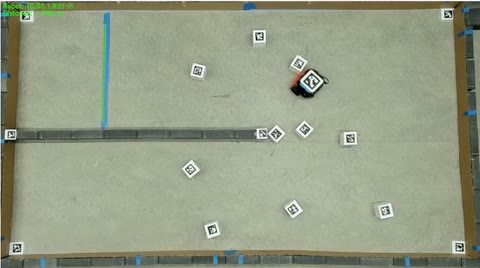 Bench-Push: Benchmarking Pushing-based Navigation and Manipulation Tasks for Mobile RobotsNinghan Zhong*, Steven Caro*, Megnath Ramesh, Rishi Bhatnagar, Avraiem Iskandar, and Stephen L. SmithIn Proceedings of the 23rd Conference on Robots and Vision (CRV), May 2026
Mobile robots are increasingly deployed in cluttered environments with movable objects, posing challenges for traditional methods that prohibit interaction. In such settings, the mobile robot must go beyond traditional obstacle avoidance, leveraging pushing or nudging strategies to accomplish its goals. While research in pushing-based robotics is growing, evaluations rely on ad hoc setups, limiting reproducibility and cross-comparison. To address this, we present Bench-Push, the first unified benchmark for pushing-based mobile robot navigation and manipulation tasks. Bench-Push includes multiple components: 1) a comprehensive range of simulated environments that capture the fundamental challenges in pushing-based tasks, including navigating a maze with movable obstacles, autonomous ship navigation in ice-covered waters, box delivery, and area clearing, each with varying levels of complexity; 2) novel evaluation metrics to capture efficiency, interaction effort, and partial task completion; and 3) demonstrations using Bench-Push to evaluate example implementations of established baselines across environments. Bench-Push is open-sourced as a Python library with a modular design. The code, documentation, and trained models can be found at https://github.com/IvanIZ/BenchNPIN.
@inproceedings{zhong2026benchpush,
  title = {{Bench-Push}: Benchmarking Pushing-based Navigation and Manipulation Tasks for Mobile Robots},
  author = {Zhong, Ninghan and Caro, Steven and Ramesh, Megnath and Bhatnagar, Rishi and Iskandar, Avraiem and Smith, Stephen L.},
  booktitle = {Proceedings of the 23rd Conference on Robots and Vision (CRV)},
  year = {2026},
  month = may,
  doi = {10.21428/d82e957c.1918581f},
}
2025
- ICRA 2025
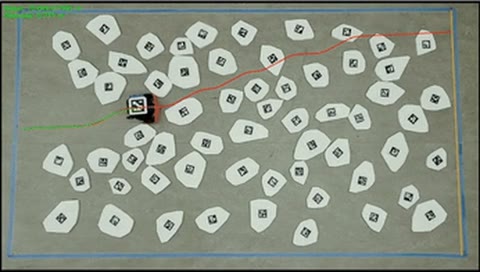 Autonomous Navigation in Ice-Covered Waters with Learned Predictions on Ship-Ice InteractionsNinghan Zhong, Alessandro Potenza, and Stephen L. SmithIn IEEE International Conference on Robotics and Automation (ICRA), May 2025
Autonomous navigation in ice-covered waters poses significant challenges due to the frequent lack of viable collision-free trajectories. When complete obstacle avoidance is infeasible, it becomes imperative for the navigation strategy to minimize collisions. Additionally, the dynamic nature of ice, which moves in response to ship maneuvers, complicates the path planning process. To address these challenges, we propose a novel deep learning model to estimate the coarse dynamics of ice movements triggered by ship actions through occupancy estimation. To ensure real-time applicability, we propose a novel approach that caches intermediate prediction results and seamlessly integrates the predictive model into a graph search planner. We evaluate the proposed planner both in simulation and in a physical testbed against existing approaches and show that our planner significantly reduces collisions with ice when compared to the state-of-the-art. Codes and demos of this work are available at https://github.com/IvanIZ/predictive-asv-planner.
@inproceedings{zhong2025ice, title = {Autonomous Navigation in Ice-Covered Waters with Learned Predictions on Ship-Ice Interactions}, author = {Zhong, Ninghan and Potenza, Alessandro and Smith, Stephen L.}, booktitle = {IEEE International Conference on Robotics and Automation (ICRA)}, pages = {10157--10163}, year = {2025}, month = may, doi = {10.1109/ICRA55743.2025.11128202}, } - T-RO 2025
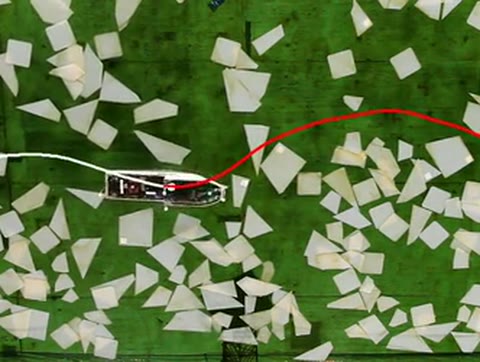 AUTO-IceNav: A Local Navigation Strategy for Autonomous Surface Ships in Broken Ice FieldsRodrigue de Schaetzen, Alexander Botros, Ninghan Zhong, Kevin Murrant, Robert Gash, and Stephen L. SmithIEEE Transactions on Robotics, 2025
Ice conditions often require ships to reduce speed and deviate from their main course to avoid damage to the ship. In addition, broken ice fields are becoming the dominant ice conditions encountered in the Arctic, where the effects of collisions with ice are highly dependent on where contact occurs and on the particular features of the ice floes. In this paper, we present AUTO-IceNav, a framework for the autonomous navigation of ships operating in ice floe fields. Trajectories are computed in a receding-horizon manner, where we frequently replan given updated ice field data. During a planning step, we assume a nominal speed that is safe with respect to the current ice conditions, and compute a reference path. We formulate a novel cost function that minimizes the kinetic energy loss of the ship from ship-ice collisions and incorporate this cost as part of our lattice-based path planner. The solution computed by the lattice planning stage is then used as an initial guess in our proposed optimization-based improvement step, producing a locally optimal path. Extensive experiments were conducted both in simulation and in a physical testbed to validate our approach.
@article{deschaetzen2025autoicenav,
  title = {{AUTO-IceNav}: A Local Navigation Strategy for Autonomous Surface Ships in Broken Ice Fields},
  author = {{de Schaetzen}, Rodrigue and Botros, Alexander and Zhong, Ninghan and Murrant, Kevin and Gash, Robert and Smith, Stephen L.},
  journal = {IEEE Transactions on Robotics},
  volume = {41},
  pages = {5875--5895},
  year = {2025},
  doi = {10.1109/TRO.2025.3613472},
}
2024
- RA-L 2024
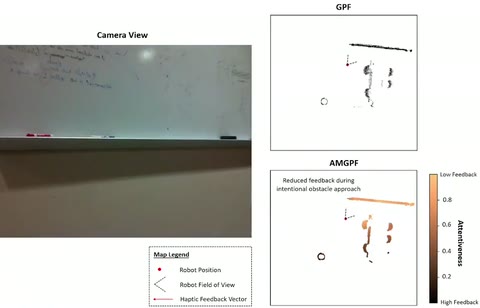 Attentiveness Map Estimation for Haptic Teleoperation of Mobile Robot Obstacle Avoidance and ApproachNinghan Zhong and Kris HauserIEEE Robotics and Automation Letters, Mar 2024
Haptic feedback can improve safety of teleoperated robots when situational awareness is limited or operators are inattentive. Standard potential field approaches increase haptic resistance as an obstacle is approached, which is desirable when the operator is unaware of the obstacle but undesirable when the movement is intentional, such as when the operator wishes to inspect or manipulate an object. This paper presents a novel haptic teleoperation framework that estimates the operator’s attentiveness to obstacles and dampens haptic feedback for intentional movement. A biologically-inspired attention model is developed based on computational working memory theories to integrate visual saliency estimation with spatial mapping. The attentiveness map is generated in real-time, and our system renders lower haptic forces for obstacles that the operator is estimated to be aware of. Experimental results in simulation show that the proposed framework outperforms haptic teleoperation without attentiveness estimation in terms of task performance, robot safety, and user experience.
@article{zhong2024attentiveness,
  title = {Attentiveness Map Estimation for Haptic Teleoperation of Mobile Robot Obstacle Avoidance and Approach},
  author = {Zhong, Ninghan and Hauser, Kris},
  journal = {IEEE Robotics and Automation Letters},
  volume = {9},
  number = {3},
  pages = {2152--2159},
  year = {2024},
  month = mar,
  doi = {10.1109/LRA.2024.3354613},
}
2023
- ICRA 2023
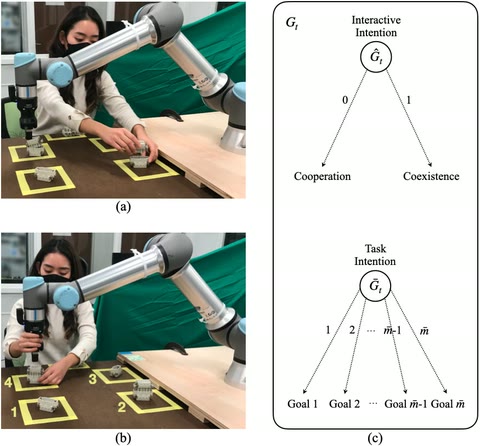 Hierarchical Intention Tracking for Robust Human-Robot Collaboration in Industrial Assembly TasksZhe Huang*, Ye-Ji Mun*, Xiang Li†, Yiqing Xie†, Ninghan Zhong†, Weihang Liang, Junyi Geng, Tan Chen, and Katherine Driggs-CampbellIn IEEE International Conference on Robotics and Automation (ICRA), May 2023
Collaborative robots require effective human intention estimation to safely and smoothly work with humans in less structured tasks such as industrial assembly, where human intention continuously changes. We propose the concept of intention tracking and introduce a collaborative robot system that concurrently tracks intentions at hierarchical levels. The high-level intention is tracked to estimate human’s interaction pattern and enable robot to (1) avoid collision with human to minimize interruption and (2) assist human to correct failure. The low-level intention estimate provides robot with task-related information. We implement the system on a UR5e robot and demonstrate robust, seamless and ergonomic human-robot collaboration in an ablative pilot study of an assembly use case. Our robot demonstrations and videos are available at https://sites.google.com/view/hierarchicalintentiontracking.
@inproceedings{huang2023hierarchical,
  title = {Hierarchical Intention Tracking for Robust Human-Robot Collaboration in Industrial Assembly Tasks},
  author = {Huang, Zhe and Mun, Ye-Ji and Li, Xiang and Xie, Yiqing and Zhong, Ninghan and Liang, Weihang and Geng, Junyi and Chen, Tan and Driggs-Campbell, Katherine},
  booktitle = {IEEE International Conference on Robotics and Automation (ICRA)},
  pages = {9821--9828},
  year = {2023},
  month = may,
  doi = {10.1109/ICRA48891.2023.10160515},
}